
Why Tire Pressure Changes in Hot Weather—and What Drivers Should Do
Why Tire Pressure Changes in Hot Weather—and What Drivers Should Do
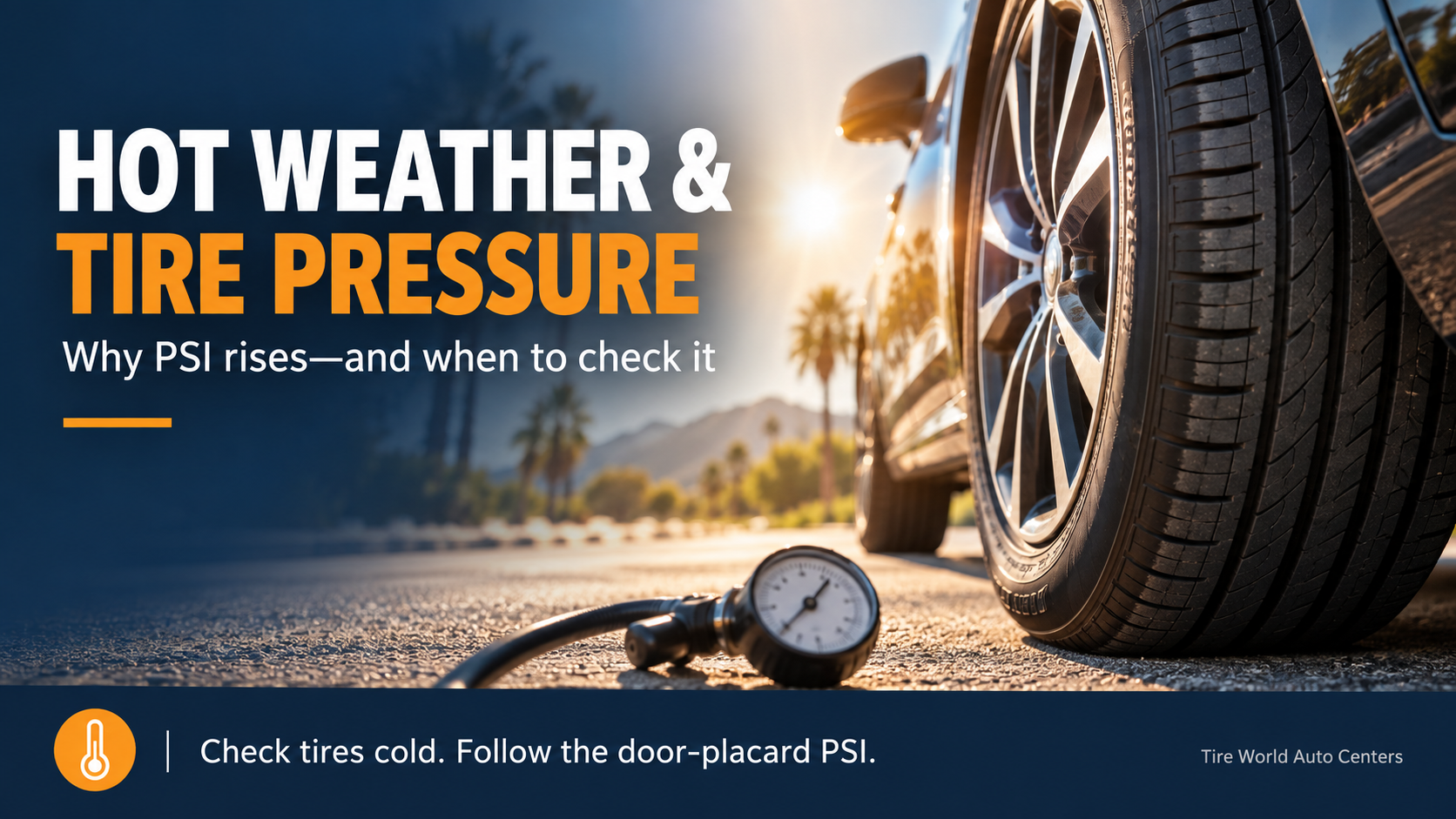
Tire pressure rises as temperatures increase because the air inside the tire expands with warmer temperatures. As a practical rule, tire pressure typically changes by about 1-2 PSI for every 10 F change in temperature.
That means a tire set to 35 PSI on a cool morning may read several PSI higher on a hot afternoon. Driving also heats the tire, causing pressure to rise even further.
In most cases, this increase is completely normal. Drivers generally should not release air from a hot tire simply because its pressure is above the vehicle’s recommended cold pressure.
The correct approach is to check and adjust tire pressure when the tires are cold using the pressure listed on the vehicle’s door placard.
Tire World Auto Centers provides tire and tire-pressure services in Frederick, MD, for drivers who need pressure checks, puncture inspections, TPMS service, new tires, balancing, or alignment.
Why Does Tire Pressure Increase When It Gets Hot?
Tire pressure increases with temperature because warmer air molecules move faster and exert more pressure inside the tire.
A tire is essentially a flexible pressure vessel filled with compressed air.
When the temperature of that air rises, the molecules move faster. Because the tire’s internal volume cannot increase enough to completely offset that change, measured pressure rises.
The opposite occurs when temperatures fall.
This is why drivers often notice:
- Higher tire pressures during hot summer weather
- Lower pressures after a cold front
- TPMS lights appear on cold mornings
- Pressure is increasing after highway driving
The tire is not necessarily gaining or losing air during these short-term changes. The same amount of air can produce a different pressure depending on its temperature.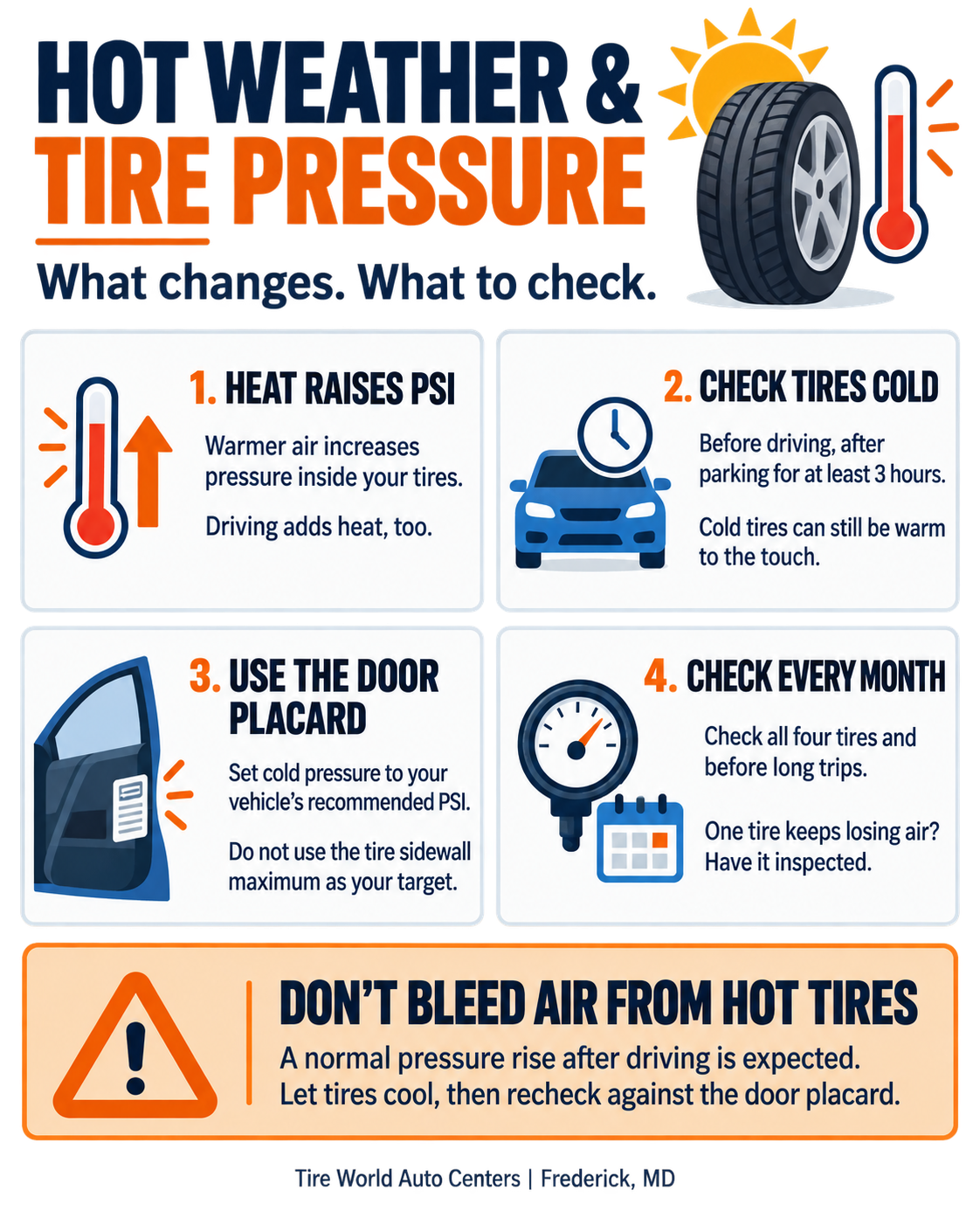
How Much Does Tire Pressure Change With Temperature?
Expect approximately 1-2 PSI of tire-pressure change for every 10 F change in temperature.
Suppose your tires are set to 35 PSI at 60 F.
If the ambient temperature eventually reaches 90°F, a 30°F increase could increase pressure by roughly 3-6 PSI, depending on the tire and conditions.
Likewise, if a tire measures 35 PSI in warm weather and the temperature later falls by 30 F, pressure may decrease several PSI.
This is an approximation rather than an exact conversion because tire construction, operating temperature, load, sunlight, driving conditions, and other factors also affect pressure.
The important point is that several PSI fluctuations can occur even when the tire has no leak.
Why Does Tire Pressure Rise After Driving?
Driving heats the tire through flexing, road friction, braking, and heat from the surrounding vehicle, so a warm tire normally has a higher pressure than the same tire when cold.
Every time a tire rotates, its tread and sidewalls flex as they enter and leave the contact patch.
That repeated deformation generates heat.
Highway speeds, heavy loads, hot pavement, aggressive driving, and long trips can further increase tire temperatures.
It is therefore normal for tire pressure to rise after driving. In some vehicles and conditions, operating pressure may be several PSI higher than the cold reading.
This is why the recommended pressure on your vehicle is specified as a cold inflation pressure.
What Is Considered a Cold Tire?
For routine pressure checks, a cold tire is generally one that has been parked for at least three hours and has not recently been heated substantially by driving.
“Cold” does not mean the tire must physically feel cold or that the weather outside must be cool.
A tire can be considered cold on an 85 F summer morning if the vehicle has been parked long enough for the tire temperature to stabilize to ambient temperature.
Conversely, a tire driven for 30 minutes during a 40 F winter day is considered warm.
For the most consistent readings, check pressure:
- Before driving
- After the vehicle has been parked for several hours
- Before direct sunlight has heated one side of the vehicle excessively, when practical
This gives you a reading you can compared directly with the manufacturer’s recommended cold inflation pressure.
Should You Let Air Out of Hot Tires?
Generally, no. Do not bleed air from a properly inflated tire simply because its pressure increased after driving.
This is one of the most common tire pressure mistakes.
Suppose your vehicle calls for 35 PSI cold.
You check the tire after an hour of highway driving and see 39 PSI.
If you release air until the hot tire reads 35 PSI, the pressure will fall further once the tire cools. You could wake up the next morning with the tire significantly underinflated.
The higher hot reading is expected.
Instead, allow the tire to cool and check it again against the manufacturer’s cold-pressure specification.
What If My Tire Pressure Is High Before I Drive?
If a tire is inflated above the vehicle manufacturer’s recommended pressure, adjust it to the specified cold pressure.
There is an important difference between:
35 PSI recommended → 39 PSI after driving
and
35 PSI recommended → 39 PSI before the vehicle has been driven
The first may be a perfectly normal operating pressure.
The second means the tire is actually overinflated relative to the vehicle specification, assuming the gauge is accurate.
If seasonal heat causes your cold pressure to rise above the specification, adjust it when the tire is cold.
What PSI Should My Tires Be in Hot Weather?
Use the vehicle manufacturer’s recommended cold tire pressure year-round unless the manufacturer provides different instructions for a particular load or operating condition.
Do not automatically add or subtract several PSI simply because it is summer.
The recommended pressure is listed on the Tire and Loading Information placard, usually located on the driver’s doorjamb or doorframe. It may also appear in the owner’s manual.
For example, if the placard says:
Front: 35 PSI
Rear: 35 PSI
then the target remains 35 PSI when cold, whether the morning temperature is 40 F or 90 F.
The tire will naturally increase above that pressure as it warms during operation.
Should I Use the PSI Written on the Tire Sidewall?
No. The pressure molded onto the tire sidewall is not normally the vehicle’s recommended everyday inflation pressure.
The sidewall marking identifies tire-specific limits and specifications.
The vehicle manufacturer determines the appropriate inflation pressure based on factors such as:
- Vehicle weight
- Axle load
- Tire size
- Suspension
- Handling
- Braking
- Load capacity
The correct everyday pressure is therefore found on the vehicle placard—not selected from the maximum pressure printed on the tire.
If you have replaced the original tires with a significantly different size or load specification, consult a qualified tire professional to confirm the correct inflation requirements.
Can Hot Weather Make a Tire Overinflated?
Hot weather can increase measured pressure, but a tire that was correctly inflated when cold is designed to experience normal pressure increases during operation.
Seeing 38 or 40 PSI in a tire that was set to 35 PSI cold does not automatically mean the tire has become dangerously overinflated.
Tires are engineered to operate across a range of temperatures and pressures.
Actual overinflation occurs when too much air is added to the tire relative to the correct cold inflation pressure, not merely because the tire’s normal operating pressure rises as it heats.
However, a large unexplained pressure difference between tires should still be investigated.
Can Tire Pressure Get Dangerously High in Summer?
Normal pressure increases from correctly inflated tires are expected, but excessive inflation, overloading, tire damage, or extreme operating conditions can increase tire stress.
Hot weather by itself is not a reason to deliberately run tires below their recommended pressure.
In fact, underinflation is particularly undesirable in hot weather because an underinflated tire flexes excessively.
That flex creates additional heat.
Combining:
high ambient temperature + underinflation + highway speed + heavy load
can generate significant tire stress.
The safer approach is to maintain the manufacturer’s specified cold pressure and make sure the tire is otherwise in good condition.
Is Underinflation More Dangerous in Hot Weather?
Yes. An underinflated tire flexes more than intended, generating additional heat that can contribute to tire damage and failure.
Air pressure supports the vehicle’s load.
When pressure is too low, the sidewalls deform more as the tire rotates.
Excessive flex creates heat and can contribute to:
- Accelerated shoulder wear
- Increased rolling resistance
- Poorer handling
- Reduced fuel economy
- Internal tire damage
- Tire failure
Summer pavement and high ambient temperatures add additional thermal stress.
For that reason, intentionally lowering tire pressure during summer is generally the opposite of what drivers should do.
Why Did My TPMS Light Turn On After the Weather Changed?
A significant temperature drop can lower tire pressure enough to activate the TPMS warning even when no tire has developed a new leak.
Imagine tires that are already a few PSI below their recommended pressure.
An overnight temperature drop of 30 F could lower pressure by another several PSI.
That may be enough to trigger the Tire Pressure Monitoring System.
TPMS is designed to warn drivers about significant underinflation, but it does not replace regular pressure checks.
Tire World provides TPMS service in Frederick, MD for warning lights, sensor problems, dead sensor batteries, programming, and relearn procedures.
Will the TPMS Light Turn Off When It Gets Warm Again?
It might, but a TPMS light that disappears as temperatures rise can still indicate that the tires need air.
If pressure is near the warning threshold, colder temperatures may push it below the threshold and warmer temperatures may raise it above the threshold again.
The warning may therefore appear in the morning and disappear later in the day.
Do not assume that means nothing is wrong.
Check all four tires with an accurate pressure gauge when they are cold and adjust them to the door-placard specification.
Does TPMS Show the Exact Pressure I Should Use?
No. TPMS measures or monitors tire pressure; it does not determine the correct pressure specification for the vehicle.
Many modern vehicles display individual tire pressures on the dashboard.
That makes monitoring convenient, but you still need the driver’s door placard to determine whether those pressures are correct.
Some systems also update readings only after the vehicle begins moving.
If the dashboard reading and a quality handheld gauge differ substantially, the TPMS sensor or gauge may need to be checked.
Why Is One Tire Always Lower Than the Others?
If one tire repeatedly loses pressure while the others remain stable, suspect a leak rather than a normal temperature change.
Temperature affects all four tires.
A tire that loses several PSI more than the others may have:
- A nail or screw
- Valve-stem leak
- Valve-core leak
- Bead leak
- Wheel corrosion
- Impact damage
- Improper previous repair
Adding air repeatedly does not fix the underlying problem.
A slow leak should be inspected before continued underinflation causes internal tire damage.
Drivers who need a puncture inspection or a replacement tire can visit Tire World’s tire shop in Frederick.
Does Sunlight Affect Tire Pressure?
Yes. Direct sunlight can heat tires unevenly and create temporary pressure differences between the sunny and shaded sides of a parked vehicle.
You might check a car in an afternoon parking lot and find that the tires facing direct sunlight read slightly higher.
This does not necessarily indicate an inflation problem.
For the most consistent comparison between tires, measure them before driving after they have been parked under similar conditions.
This is another reason early-morning pressure checks are often convenient.
How Often Should You Check Tire Pressure?
Check tire pressure at least once a month and before long trips, heavy loads, or towing.
TPMS provides an important safety warning, but it should not be your only pressure-checking strategy.
A tire can be underinflated without triggering the warning.
Monthly checks also make it easier to spot gradual pressure loss before it becomes severe.
An inexpensive digital or dial tire gauge is sufficient for most drivers as long as it produces consistent readings.
Does Proper Tire Pressure Affect Tire Wear?
Yes. Incorrect pressure changes how the tread carries load against the road and can accelerate uneven wear.
Underinflation commonly increases stress and wear toward the shoulders.
Excessive inflation for the vehicle and load can change tread loading and may contribute to increased center wear in some applications.
Pressure is not the only cause of irregular wear.
Alignment, suspension condition, rotation intervals, and driving habits also matter.
If tires continue to wear unevenly despite correct pressure, Tire World offers wheel alignment service to measure toe, camber, and caster and identify alignment-related tire wear.
Does Tire Pressure Affect Fuel Economy?
Yes. Underinflated tires create additional rolling resistance, requiring the engine to use more energy to move the vehicle.
A tire deforms continuously as it rolls.
Underinflation increases that deformation and the energy lost through heat.
Correct pressure therefore supports both tire life and fuel efficiency.
It also helps preserve the steering, braking, and handling characteristics the vehicle manufacturer intended.
Should You Check Tire Pressure Before a Summer Road Trip?
Yes. Check cold pressure, tread condition, and visible tire damage before long-distance summer driving.
Highway trips combine several factors that increase tire workload:
- Sustained speed
- Heavy luggage
- Passengers
- Hot pavement
- Long operating periods
Before leaving, set each cold tire to the vehicle manufacturer’s recommended pressure and inspect for cuts, bulges, punctures, cracking, and unusual tread wear.
If you notice vibration at highway speeds, tire balance may also need attention. Tire World provides tire balancing to correct wheel-and-tire imbalance that can cause vibration and irregular wear.
What Should Drivers Do When Temperatures Rise?
Check pressure cold, use the door-placard specification, and allow normal pressure increases after driving.
The practical summer tire pressure routine is simple:
- Let the vehicle sit for at least several hours.
- Find the recommended cold PSI on the driver’s door placard.
- Measure every tire with a reliable gauge.
- Add or release air as necessary while the tires are cold.
- Reinstall the valve caps.
- Inspect the tires for damage and unusual wear.
- Leave normal hot-pressure increases alone.
Do not intentionally underinflate tires because the weather forecast calls for extreme heat.
Set them correctly when cold and allow the tires to compensate naturally as operating temperature changes.
Tire Pressure and Tire Service in Frederick, MD
Summer heat can change tire-pressure readings considerably, but the solution is not complicated.
Set your tires to the vehicle manufacturer’s recommended cold pressure, and do not bleed off the normal pressure increase that occurs after driving.
Drivers should also remember that temperature changes affect all four tires in similar ways. A single tire that repeatedly loses pressure deserves an inspection for a puncture, valve leak, bead leak, or other problem.
Tire World Auto Centers provides new tires and tire service, TPMS diagnostics, wheel alignment, and tire balancing at its Frederick, Maryland locations.
Regular pressure checks are among the simplest ways to protect tire life, fuel economy, handling, and safety through Maryland’s summer temperature swings.